Free quotes across Greenwood, Ninety Six, Ware Shoals & all of Greenwood County — call any day of the week
Home › Storm & Emergency

Storm & Emergency Tree Work

Trunk on the shingles. Oak owning the driveway. A hanger swinging over the back door. Skip the form — this is the situation the phone is for.

Call Now (864) 786-6890 Not Urgent? Use the Form

Power lines change everything

If any part of the tree is in contact with a line, leaning toward one, or brought one down — stop right there. Keep people and pets away and call Duke Energy or your electric cooperative, or 911, before you call about tree work. No tree crew works energized lines; that's the utility's job, and a line lying quiet in wet grass can still be live. Helene left nearly the whole county dark for a reason — lines and trees came down together. The utility clears its hazard, then the tree work begins.

When a trunk has breached the roof, clear everyone away from that end of the house before you start making calls.

How storm work actually runs

Greenwood County's tree emergencies come from three directions: summer thunderstorm lines rolling off the mountains, the odd January ice night that loads every pine limb past its limit, and — as 2024 proved — the remains of a hurricane that didn't fully quit before reaching the Piedmont. The working order is always the same: make it safe, stop the bleeding, then finish. Getting the trunk's weight off your rafters and a tarp over the hole tonight matters more than hauling brush tomorrow.

When you call, be ready to say what fell, what it's on, and whether a truck can reach it. After a county-wide event everyone calls the same week, so jobs run in order of danger: occupied house first, blocked drive second, limb on the fence when the real hazards are cleared. You'll get a straight answer about where you land in that line.
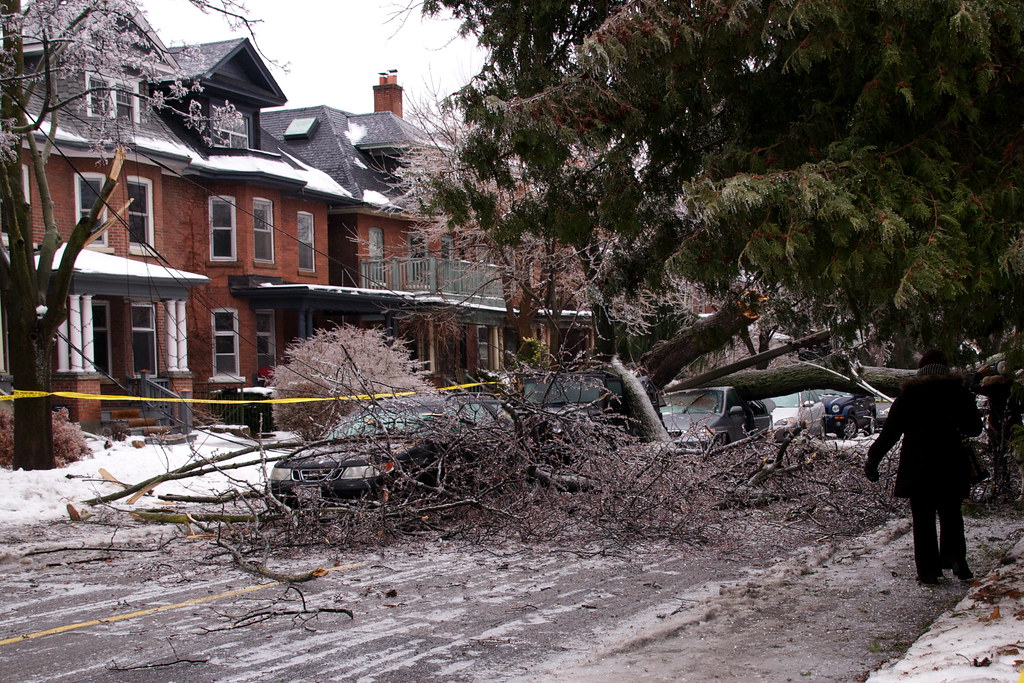
Storm-felled tree crushing a vehicle beside a home
Photo: iRonInk, CC BY 2.0

Thinking about an insurance claim?

Photograph first, move second. Wide shots and close shots of what fell, what it hit, and everything around them — before a single limb is cut. Save every receipt, tarps included. Policies can read a trunk through the rafters one way and a tree lying harmlessly on grass another, and no two policies read alike, so let your insurer tell you what yours covers rather than assuming. What the tree professional adds to your file is a written record of what was done, which your adjuster will ask for either way.

Emergency questions

How fast is 'priority'?

An occupied structure with a trunk on it, or a driveway you can't leave by, tops the schedule without argument. After a widespread storm, honest sequencing replaces promises: describe your situation plainly and you'll hear a real timeline, not a guess designed to win the job.

It's my neighbor's tree on my carport. Who pays?

That question gets settled between insurance companies more often than between neighbors, and what decides it is the tree's prior condition plus the language in both policies. We don't give legal advice — document everything, call your insurer, and let the adjusters sort liability while the tree itself gets dealt with.

Can they tarp the roof, or just cut the tree?

Ask when you call. Lifting the weight off and covering the opening is standard storm response, and it's what keeps a bad Friday from becoming a ruined ceiling by Monday.

Storm mess in the yard right now? Call and lay it out plain — danger sets the order.

Call (864) 786-6890  More Questions
📞 (864) 786-6890